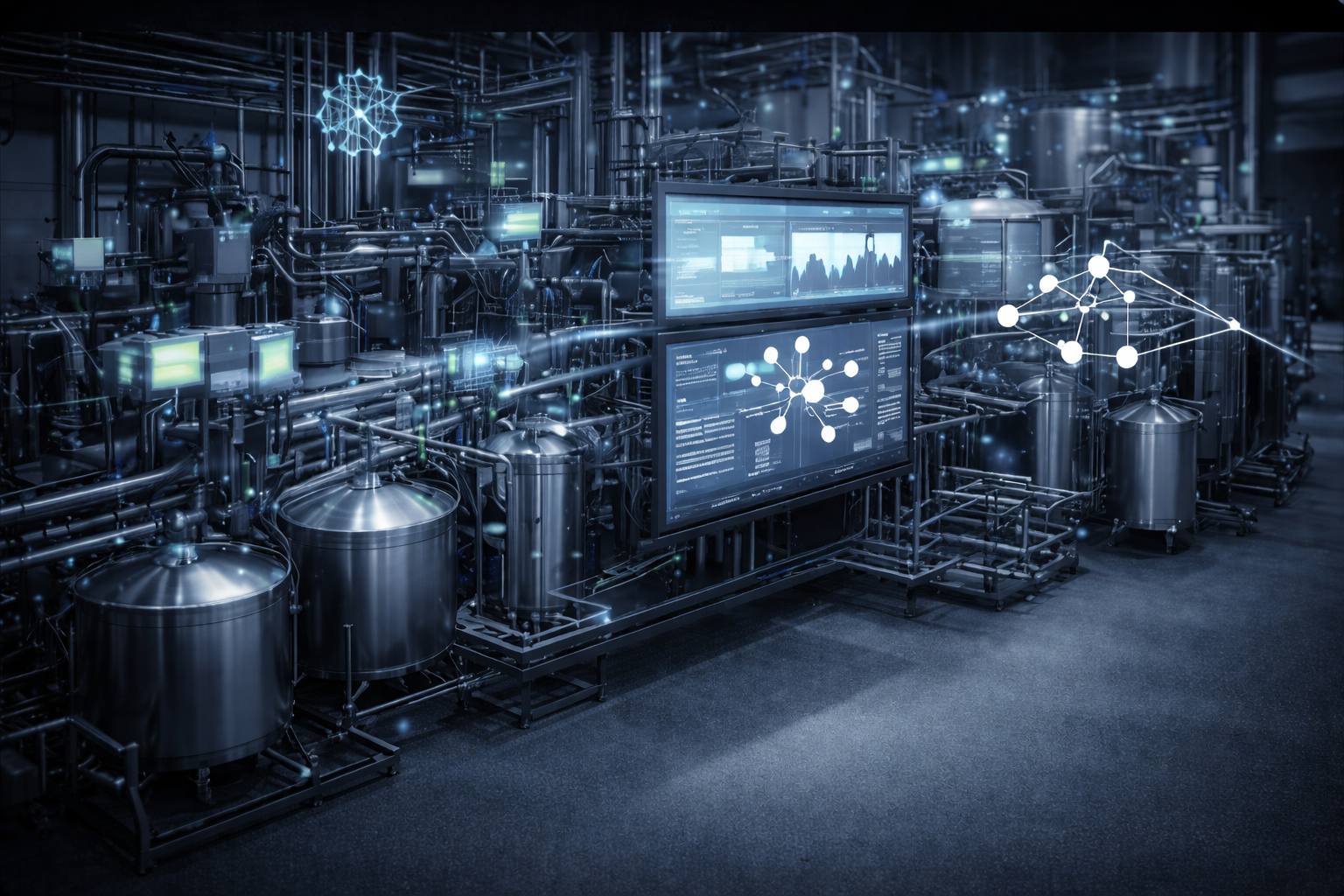
Use Case 1 - Deep Learning AI Model for Chocolate Manufacturing
Built from first principles of Engineering and Mathematics (see ellipse diagram), a cutting-edge Neural network is designed for Mondelez International India manufacturing plant to precisely control Weight of chocolate getting deposited in moulds in Closed feedback loop. Architecture below:
NETWORK ARCHITECTURE
(In General)
(Sensors / PLC / DCS)
Double Encryption
- mTLS (HTTPS) for network security
- Secured API communication only
- AES payload encryption
Mutual Authentication
- Trust certificate identity verification
- Only authorized Gateway connects
- Prevents unauthorized injection
Zone 2: Industrial DAL
Transforms raw sensor signals into statistical parameters such as Reynolds Number, Prandtl Number, Nusselt Number, Agitator Power Number, Overall Heat Transfer Coefficient, Log Mean Temperature Difference (LMTD), Residence Time Distribution (RTD), Specific Enthalpy, Compressibility Factor, Coefficient of Variation, Skewness, Covariance Matrix, Transient Response Gradients, etc.
These derived variables capture underlying transport phenomena, thermodynamic behaviour, process variability, and dynamic system responses, thereby providing stable and normalized inputs to Deep learning AI model which are pre-requisites for Neural Network calculations. Edge Server is supplied and managed by NeuralFactoryAI.
Zone 3: Data Center Computation
This zone hosts a GPU-enabled AI execution environment where Deep learning neural network processes inputs received from Industrial DAL. AI engine operates within a secured runtime, performing high-speed inference to generate outputs. It is designed for low-latency execution and continuous adaptation to process dynamics. AI execution environment is managed by NeuralFactoryAI.
From Data to Intelligence
Deep-Learning Neural Network AI systems build to transform Mondelez Manufacturing line from Traditional human controlled operation to a Real-time AI controlled operation.
For Mondelez manufacturing line, the AI model is developed from first principles of engineering and applied mathematics, incorporating core process engineering, statistical learning techniques, and advanced neural network architectures. The solution involves mathematical modeling of key process equipment, including kinematic behavior of material flow, mechanical dynamics, and inherent process non-linearities.
The complete solution includes seamless integration with your existing PLC/SCADA infrastructure along with manual quality lab data, enabling continuous closed-loop feedback automated operation.